
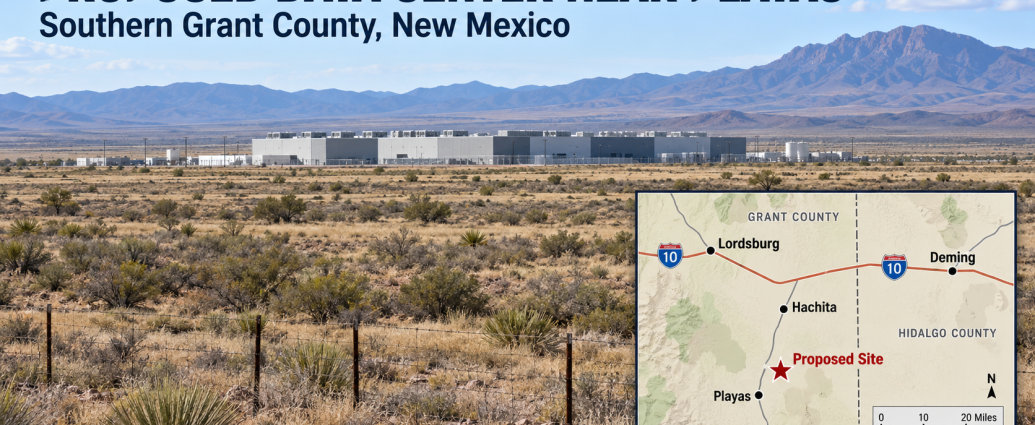

DEMING – A New York-backed company is preparing to seek state approval for a large data center on Hurt Cattle Company ranchland in southern Grant County, approximately four-and-a-half miles northeast of Playas and 11.8 miles west-northwest of Hachita.
The project, identified as “Site Layer 1,” would be constructed on private property within the approximately 30,000-acre Hurt Ranch. Although Playas is in Hidalgo County, available project information places the proposed development immediately across the county line in Grant County.
Hurt Cattle Company currently owns the ranch property. The longstanding southwestern New Mexico cattle operation lists a Deming mailing address and has ranching interests throughout the Bootheel. Publicly available information does not indicate whether Site Layer 1 has purchased the proposed site, entered into a lease or secured an option to acquire the land.
Site Layer 1, LLC reportedly plans to submit an air-quality permit application to the New Mexico Environment Department’s Air Quality Bureau by October 1. No final air-quality permit or construction approval has been issued.
Preliminary information published through a legal notice indicates the facility would generate its own electricity using 32 natural-gas-fired engines. Each engine would be capable of producing approximately 9.4 megawatts, providing a combined generating capacity of about 300.8 megawatts.
If operated continuously at the reported rate, the engines could consume approximately 2.3 million cubic feet of natural gas per hour, or more than 20 billion cubic feet annually. The proposed site is located near the Kinder Morgan El Paso Natural Gas pipeline system.
The project’s preliminary emissions estimate includes approximately 1.29 million tons of carbon-dioxide equivalent annually. Information compiled from the public notice also estimates approximately 1,529 tons per year of other pollutants, including particulate matter, sulfur dioxide, volatile organic compounds and ammonia. Precise pollutant totals and proposed emission-control equipment should become available when the complete permit application is released.
Site Layer 1, LLC has been connected through state business filings to Corner, an investment firm with offices in New York, Palo Alto, Tel Aviv and Tokyo. Corner’s website says the company has invested more than $1.7 billion in over 120 businesses. David Katz, identified by Corner as its director of legal affairs, has reportedly been listed as the authorizing individual for Site Layer 1 and similarly named data-center ventures in Colorado and Wyoming.
The identity of the company that would ultimately operate or use the New Mexico data center has not been disclosed. It is also unknown whether the center would support artificial-intelligence computing, cloud services, cryptocurrency operations or another form of high-capacity computing.
Water use remains another major unanswered question. The Gila Resources Information Project says it found no water-rights application associated with the development. The organization estimates that a facility of this capacity could consume as much as 6,535 acre-feet of water annually if it uses conventional evaporative cooling. That is an outside estimate, however, and not a confirmed water-use figure submitted by Site Layer 1.
The developer has not publicly identified its proposed cooling technology, water source or wastewater plan. Groundwater in the area comes from the Hachita Basin, which extends into portions of Grant, Hidalgo and Luna counties.
Other information not yet publicly available includes the construction cost, number of buildings, development acreage, construction schedule, permanent employment, temporary construction jobs and whether the company is seeking tax incentives or public financing.
Once the application is submitted, the Air Quality Bureau must determine whether it is administratively complete. A complete application would then be made available for review, followed by a formal public-comment period. Members of the public would be able to submit written comments and request a public hearing before NMED makes a permitting decision.
The complete application should provide considerably more information about the proposed engines, operating hours, emissions, cooling equipment and environmental controls.